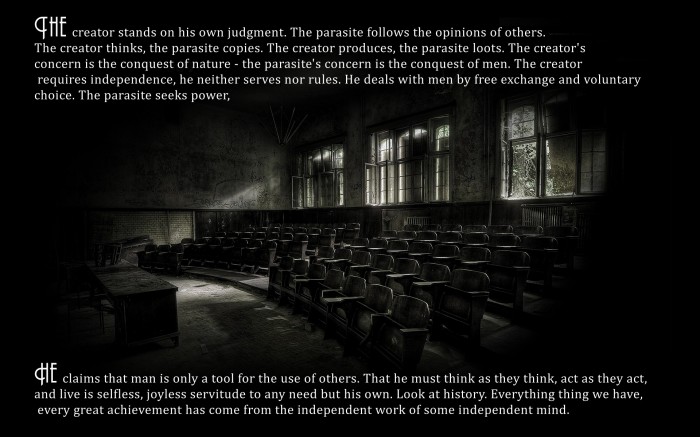
Yes, everyone in the world is either a creator or a parasite. There are no other options. Ayn Rand, your logic is flawless as usual.
And that line about ‘every great achievement’ is a laugh too, I keep trying to come up with the name of that one guy who invented Jazz music. I think he was the same guy who came up with the idea to walk on the moon and then built a rocket and flew there. All by himself.
“The essential flaw in Ayn Rand’s thinking is to make the artist the paradigm of the individualist. Overbearing as it is, this ham-fisted vision of the individual has its level of validity when applied to artists. The artist is an absolute tyrant in a world he creates himself out of his own being, disdaining all others in his dedication to his own vision. It is indeed a realm where the normative rules of common decency do not necessarily apply. It’s not unjust because any other individual is entitled to the same privileges when he makes his own work of art.
But to break the paradigm down, all you have to do is look at the person who actually perfected the electric light. This was not a case of an inspired individual working in isolation, but rather of an individual whose genius was largely in perfecting the work of dozens of inventors who preceded him and then organizing the collective effort of hundreds of nameless others in developing, implementing and exploiting it, aided and abetted by a larger collective that granted and enforced a monopoly on his invention. Thomas Edison’s greatest invention may well have been the research laboratory.”
“Utopias cannot survive long outside of their native habitat: the minds of their creators.”


 Movie Reviews

“The Creator” that made this image should have checked for typos.
Yes, everyone in the world is either a creator or a parasite. There are no other options. Ayn Rand, your logic is flawless as usual.
And that line about ‘every great achievement’ is a laugh too, I keep trying to come up with the name of that one guy who invented Jazz music. I think he was the same guy who came up with the idea to walk on the moon and then built a rocket and flew there. All by himself.
It was Jules Verne I think.
Looking to egomaniacs for sound logic is pointless.
Would you kindly shut the fuck up?
I see what you did there.
Written by a lady who received welfare.
Damn she a parasite!
“The essential flaw in Ayn Rand’s thinking is to make the artist the paradigm of the individualist. Overbearing as it is, this ham-fisted vision of the individual has its level of validity when applied to artists. The artist is an absolute tyrant in a world he creates himself out of his own being, disdaining all others in his dedication to his own vision. It is indeed a realm where the normative rules of common decency do not necessarily apply. It’s not unjust because any other individual is entitled to the same privileges when he makes his own work of art.
But to break the paradigm down, all you have to do is look at the person who actually perfected the electric light. This was not a case of an inspired individual working in isolation, but rather of an individual whose genius was largely in perfecting the work of dozens of inventors who preceded him and then organizing the collective effort of hundreds of nameless others in developing, implementing and exploiting it, aided and abetted by a larger collective that granted and enforced a monopoly on his invention. Thomas Edison’s greatest invention may well have been the research laboratory.”
“Utopias cannot survive long outside of their native habitat: the minds of their creators.”